

If you opened HelloTalk this month to look for someone to practice with, you may have run into the same wall a lot of other people describe. One reviewer put it plainly in a one-star review on the Japanese App Store, dated July 18, 2026, under the title "Why Is Searching for Native Speakers No Longer a Basic Feature?"
Here is what they wrote, word for word:
When I search for Japanese speakers, I only get people whose native language is English or other languages. That's not useful at all because I'm trying to learn Japanese. Why did you change the system? I think it makes sense to charge for extra features that aren't essential for language learning, like finding people nearby. But being able to search for people whose native language matches your target language should be a basic feature, shouldn't it?
Read that twice, because this reviewer is being unusually fair. They are not demanding that everything be free.

One important note before we go further. Whether HelloTalk actually changed this, and when, is not something we can confirm. There is no official announcement, and HelloTalk's own marketing still describes searching partners by native language. What we can say is that reviewers across both app stores, in both English and Japanese, have been reporting the same experience since spring. So everywhere below, treat it as what users say they are seeing, not as a confirmed policy.
Look again at what that person actually conceded. They agree it makes sense to charge for extras like finding people nearby. Their objection is narrower and sharper: reaching a partner whose native language matches the one you are trying to learn is not an extra. It is the reason you opened a language-exchange app in the first place. Deciding who you get to find is the product, not a bonus feature bolted on top of it.
HelloTalk's team did reply to that review, courteously, as they do to most:
We will send your feedback to our Product Team. If you have any further suggestions, please feel free to submit them via the HelloTalk Team (in your Following list) or email us at support@hellotalk.com.
Templated replies like that are normal support practice at the scale HelloTalk operates at, and there is nothing wrong with them in principle. The gentle mismatch is simply this: the reviewer was not filing a support ticket about a bug. They were describing a decision about what the free tier includes. A support redirect cannot answer a product-design question, no matter how politely it is written.
To sanity-check whether this was one loud voice or a pattern, we read the 100 most recent written reviews on the Japanese App Store and Google Play, collected on July 25, 2026. A quick but honest caveat: this is a snapshot of recent written reviews, the kind people leave when something just changed. It is not HelloTalk's lifetime rating, and you should not read it as the app's overall score.
Within that recent written sample, 49 of the 100 reviews were one star and 59 were one or two stars, for an average of 2.33. The complaints clustered into a few themes.

Ads on launch. Seven of the hundred reviews mention advertising. One, titled "Too many adds," reads: "It used to be a better app, I am lost with dozens of adds..." Another long-time user, translated from Japanese, noted that being shown an ad the moment you open the app feels intrusive.
Losing the search. Five reviews are specifically about search or language selection. One English review from May simply states: "can no longer search foreign languge users to practice..." The typos are the reviewer's own; we left the quote as written.
Dating bait and scam DMs. This was the single biggest cluster, 21 of the 100 reviews. Users describe getting pushed toward off-platform chat and receiving messages from people treating a language app as a hookup app. One review closes, translated, with a warning to "be careful about making friends here."
Sudden account freezes. Fifteen reviews describe bans or freezes that arrived without a clear reason. One English review reads: "The platform banned my account and locked my device even though haven't posted anything or talked to anybody on the app for a while. I have contacted the support team but they refuse to show me what I did wrong and refuse to restore my account." Another, translated from Japanese, describes an account frozen "with no prior warning," with the only explanation being that "there was a report."
None of that is unusual for a large platform. It is roughly what happens to a lot of apps as a free tier that was once wide open gets thinner over a decade.
A comparison that pretends the other app is terrible is a comparison nobody should trust, so let us be straight about what HelloTalk gets right.
It has one of the biggest user bases in this category, built over more than ten years, which means there is almost always someone to talk to. Its correction tools for text and voice messages are genuinely good, and they are still free. Voicerooms and the timeline feed are real, useful features, not marketing filler. And most of the core chat functionality remains free. For a lot of people, HelloTalk will keep being a fine place to practice.
So this is not a takedown. It is one observation about one design decision, and about what that decision does to the thing people actually came for.

Here is the through-line. When an app charges you to decide who you are allowed to reach, it quietly changes what it is. A language-exchange app is supposed to be a place where you find the right person and become friends with them. Gate the "find the right person" part, and what is left is a directory you pay to sort.
That is the reviewer's point, and it is a good one. Reaching a partner who speaks the language you want is not a premium tier. It is the whole product.
SewaYou starts from a different place. It is a map-based app for finding real people near you, anywhere in the world, and turning them into actual friends. It is not a study app and it is not a dating app, so there is no swiping and no algorithm deciding who you are paired with. You open it, and real people around you are simply there.
Make Japanese Friends On a Live World Map
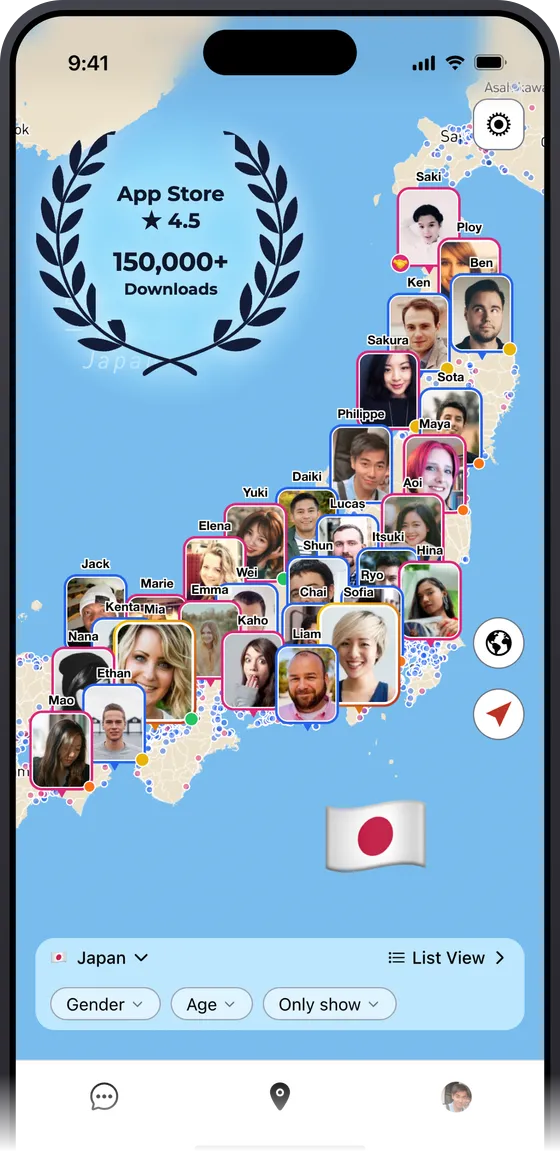
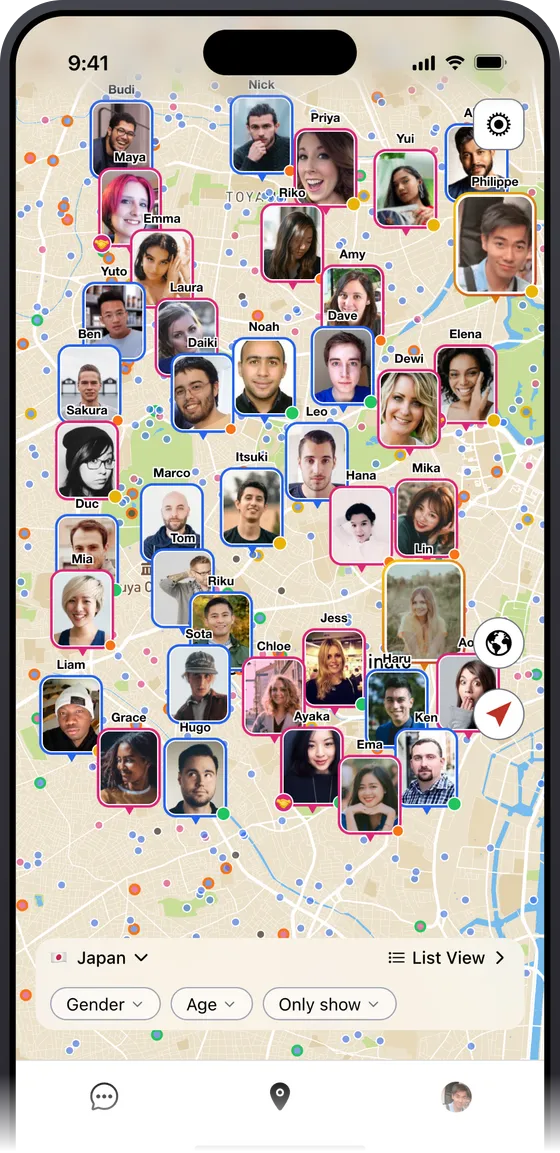
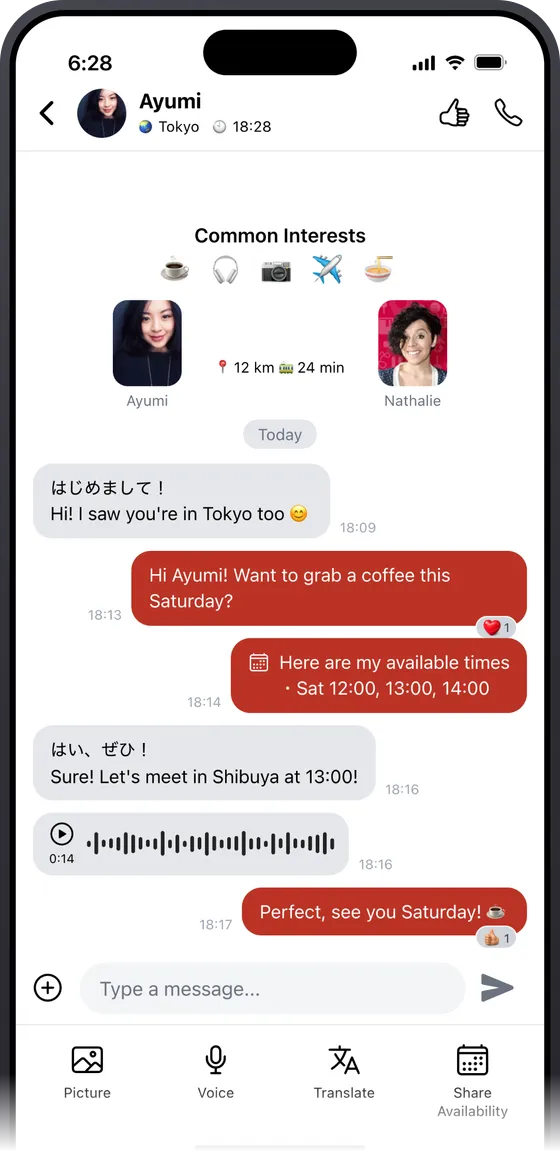


Two things matter for the exact complaint above. First, the map shows real people near you. Second, there is a dedicated toggle that lets a non-Japanese user see only Japanese natives, or lets a Japanese user hide them. It sits in its own section, and you can set it permanently from your privacy settings. That is precisely the capability the HelloTalk reviewers say they lost.
Now the honest part, because claiming everything is free would be the same move this whole article is questioning. There is a free version with limited features, and Pro unlocks more chats and features.

That is the part worth sitting with. Nobody became fluent from a search filter. People became fluent because someone near them turned into a friend they genuinely wanted to keep talking to, and the language came along for the ride. A friendship-first app is not a watered-down study tool. It is the thing the study tool was quietly trying to produce all along.
If you have been staring at a results list full of the wrong people this month, that is the itch worth scratching. SewaYou is a map-based app that shows you real people near you, so you can meet someone this weekend instead of filtering strangers you will never see in person.


