

Search for "free apps to talk with foreigners" and you will find plenty that show a payment screen right after you download them. With some, you can barely do anything for free. 😩
Try to send a message: "Pro membership required." Open a profile: "Please upgrade." If you have ever deleted an app five minutes after downloading it, you are probably not alone.

This article focuses on apps I have personally used for at least a month without paying, with an honest look at how much conversation their free versions allow. These seven choices include useful freemium options, apps where free conversations actually work, and the pitfalls to watch for.
Even when an app says "free," it usually falls into one of three categories:
The problem is that app-store descriptions rarely make the distinction clear. Many apps labeled "free to download" belong in the third category.
Before choosing one, check how many messages you can send for free, how many people you can match with, and whether search and filters work without a subscription.
One weakness shared by many apps is that conversations stay online and never become meetings. SewaYou is designed to address that by using a map to help you find nearby language exchange partners and potential friends.
Make Japanese Friends On a Live World Map
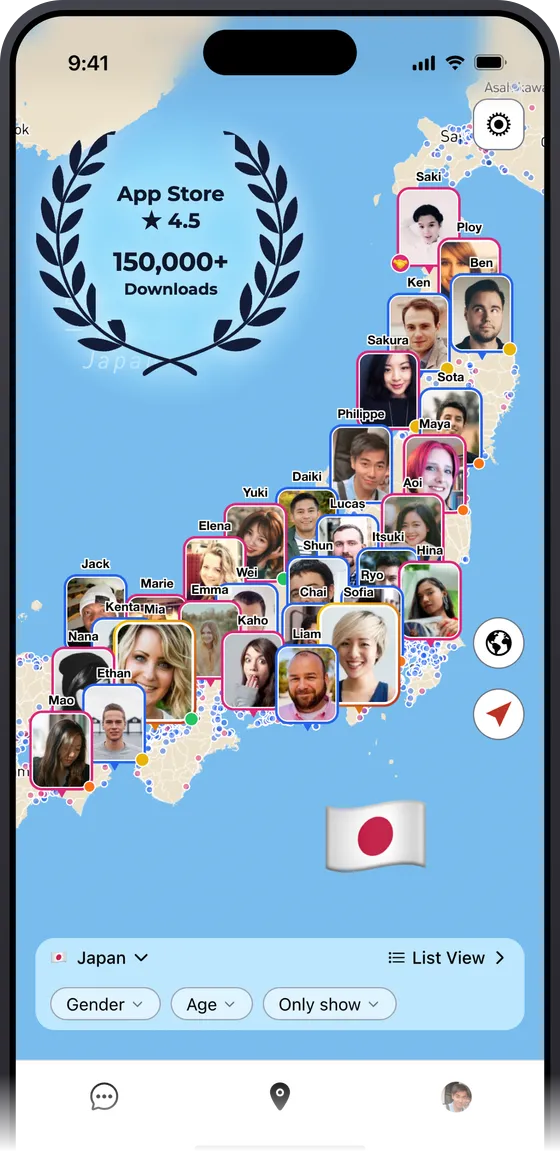
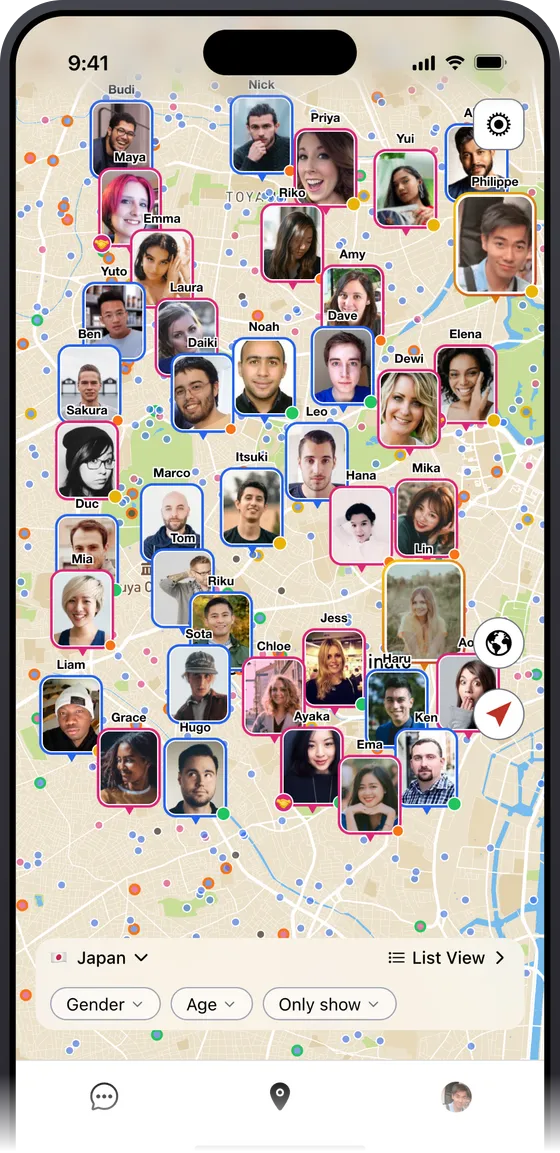
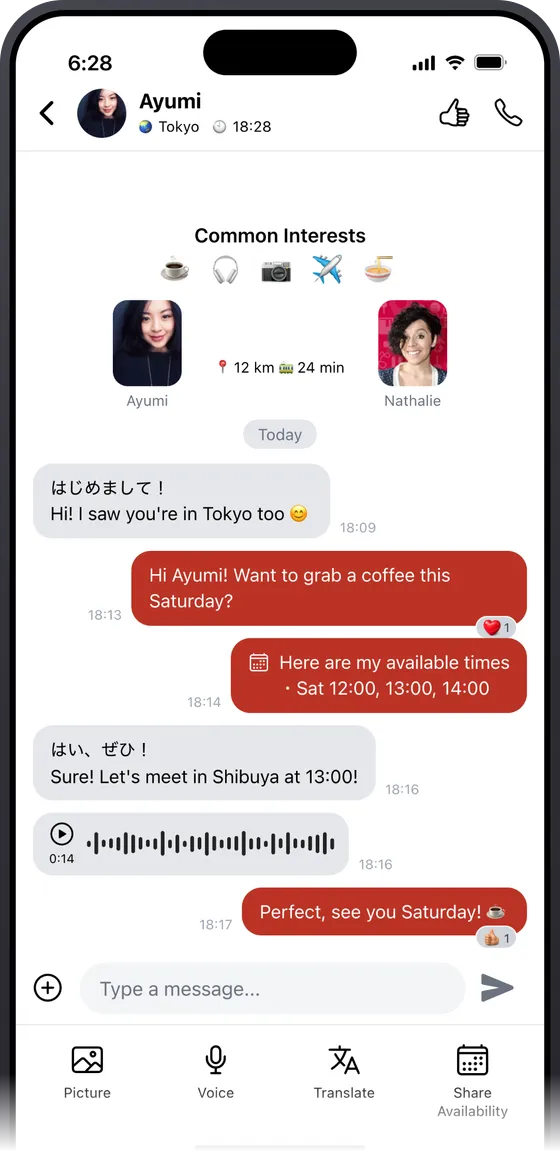


After signing up, you can find nearby people on the map and view their profiles and profile photos. There is a free version with limited features, and Pro unlocks more chats and features.
SewaYou also works wherever you live. Look for people in your own neighborhood, or move the map to another city or country and get to know people there, with or without a trip planned.
Best for: people who want to meet foreigners nearby or make friends anywhere in the world.
HelloTalk is a major language exchange app with users around the world. One especially useful feature is having native speakers correct your timeline posts. Posting and receiving corrections are available for free.
However, the free plan limits direct messaging, and some ways of narrowing down language learners, such as multiple-language filters, require payment. If you want to message many new people every day, that can feel restrictive.
Translation and text-to-speech are available for free. Its enormous user base also gives you plenty of opportunities to encounter people from other countries without paying.
The downside is that many users live overseas, so time differences can interrupt conversations. You may also occasionally receive strange messages from people looking for dates.
Best for: people who mainly want language practice and lots of opportunities to interact with foreigners for free.
Tandem has much the same concept as HelloTalk, but its free-plan restrictions feel less demanding to me, including the way it counts new direct messages. Profile reviews also help reduce spam.
The free plan limits video calls and certain language filters, but if you mainly use text, you can have real conversations without paying.
Its weaknesses are a smaller user base than HelloTalk and limited tools for finding people who live in Japan.
Best for: people tired of HelloTalk's pressure to upgrade who mainly want text-based conversations.
Bumble BFF is the friendship mode of the Bumble matching app. Unlike its regular dating mode, BFF allows unlimited swiping and matching for free. It is close to a fully usable free experience.

In Tokyo and Osaka, you will come across some foreign residents. If you are familiar with swipe-based interfaces, it takes almost no time to learn. One person needs to send a message within 24 hours of matching or the match expires, which helps keep matches from sitting untouched.
The weakness is that you cannot filter specifically for foreigners. Japanese users make up the majority, so matching with a foreigner involves some luck. It is also a photo-focused interface, so an unappealing profile photo can get you passed over, just as on a dating app.
Best for: people who want new friends for free, whether or not those friends are foreigners.
The app itself is free, and you can find events and groups that interest you without paying. Tokyo, Osaka, and Kyoto have plenty of international meetups, including English conversation cafes, language exchange nights, and hiking groups.
Event prices depend on the organizer. Some events are free; others cost around ¥1,500 to ¥3,000. As a tool for finding events, the app is effectively free to use.
Its weakness is that one-to-one messaging is secondary: the main idea is to attend events. You need the courage to go alone, and some people who sign up do not show up.
Best for: people who would rather meet in person immediately than get to know someone online first.
InterPals has existed since 2002. Signing up, sending messages, and viewing profiles are all free. Advertising is relatively limited, and paid plans are almost nonexistent.
People sign up from around the world. It can still appeal to you if you enjoy slow, letter-like exchanges. The interface is old, but my impression is that this also acts as a filter, leaving people who are serious about that kind of communication.
The downsides are spam and strange messages, plus relatively few users living in Japan. It is not a strong fit if your goal is to meet in person.
Best for: people who want to build pen-pal relationships slowly online or practice writing English.
Discord is more of a chat platform than a dedicated language exchange app. But its language exchange servers, including large Japanese-English communities, are free to join, and their voice channels make casual spoken conversations possible.

Enter a lobby and write "Hi, anyone wanna chat?" and someone will often respond. Text channels are also an easy place to ask questions about slang.
The downside is that the atmosphere varies dramatically between servers. Some are poorly moderated or attract people looking for dates, so start with a large, well-run community.
Best for: people who want casual voice conversations and feel comfortable with gaming culture or English-speaking internet communities.

If you want to talk with foreigners while spending as little as possible, I recommend using these three together:
You can also add Discord language exchange servers and InterPals, which are both free. Combining tools to cover their gaps is a realistic way to keep spending down.
What I would avoid is an app that advertises free use but blocks your very first message behind a paywall. If its app-store reviews repeatedly say "you cannot use it for free," that is usually a useful warning.
Because free plans have restrictions, the quality of each message can make a difference to the replies you receive.
Simply state your purpose and location in your profile, such as "Living in Japan and looking for English conversation in Tokyo." That reduces mismatches and wasted exchanges. It also helps to move on instead of repeatedly messaging someone who does not reply.
When you meet someone through a free app, I recommend moving toward an in-person plan fairly early, such as "Would you like to grab coffee sometime?" If your interaction stays entirely inside the app, paid features can start to seem more convenient, making the pressure to upgrade harder to resist.
Talking with foreigners through free apps is still possible in 2026. But there is a big difference between a useful free version and something that barely goes beyond a trial.
Try several without paying, then keep the ones that fit where you live and what you want. There is no need to pay immediately; you can wait until you know you will use an app every day.
Download SewaYou and start by seeing which foreigners are nearby.


