

Most "best app" lists pretend safety is a tiebreaker. Safety isn't a tiebreaker, it's the whole game. When you're chatting with strangers on the other side of the planet, most of whom you'll never meet in person, the question of who can reach you and how protected you are matters more than user count, language-detection accuracy, or any other "feature" the reviews fixate on.
Let's stop ranking apps by how big they are and start ranking them on the dimensions that decide whether you'll still be using the app in three months.
When I evaluate a social app now, I run it through the same six checks:

An app can have fifty million users and still fail four of these. Most do.
Disclosure: we make SewaYou. This is our explanation of where it fits alongside the other apps.
SewaYou is a map-based friendship app for meeting people nearby and anywhere in the world. Explore your own neighborhood or move the map to another city or country, all from where you are now.
Make Japanese Friends On a Live World Map
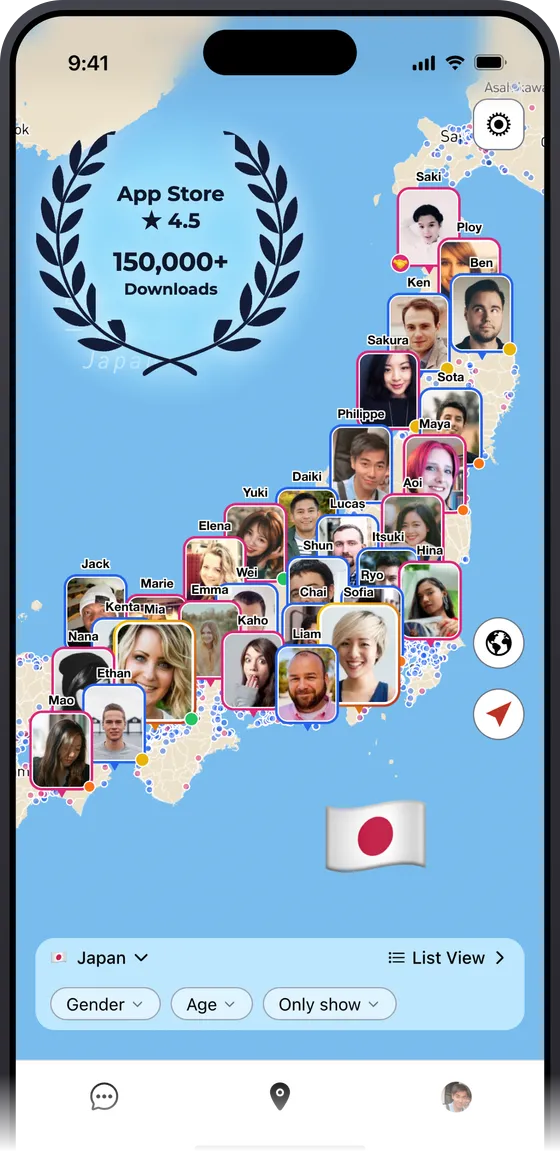
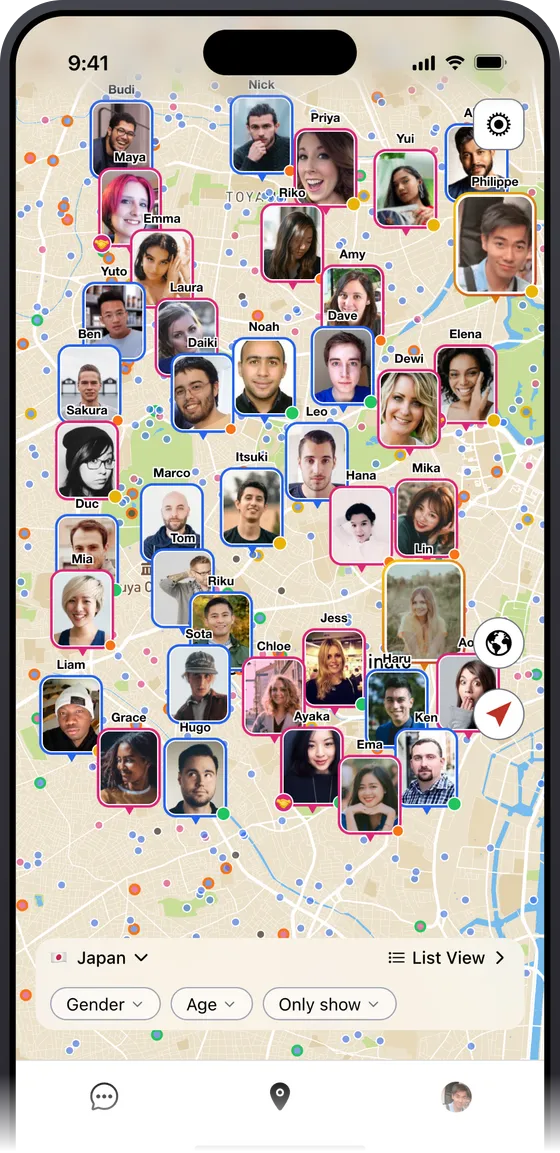
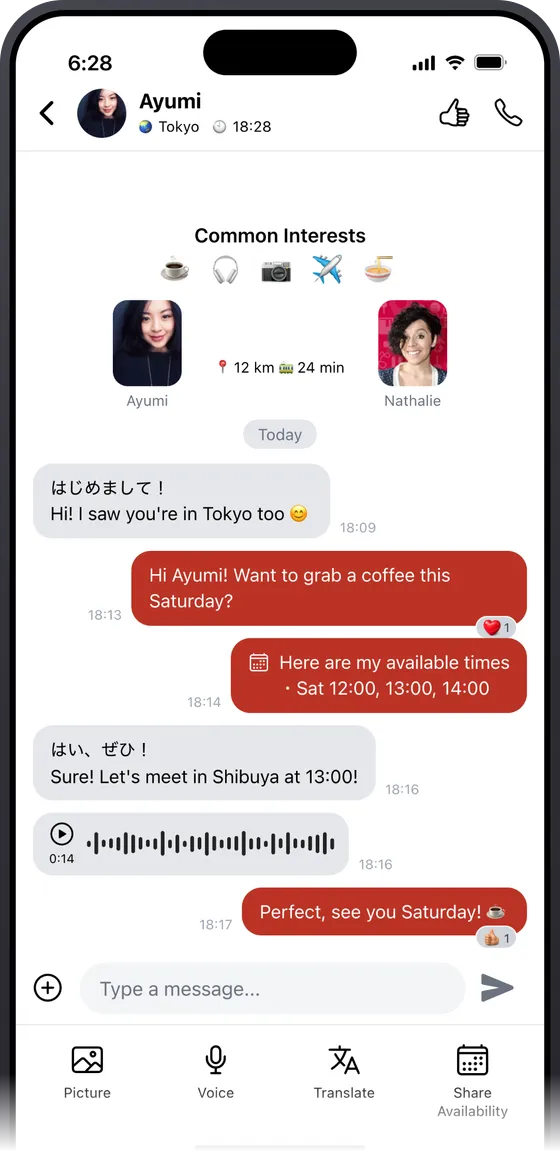


Stay close to home to find someone you could invite for coffee, or explore another country to make friends online. You can also get to know people at a future travel destination before you leave. You do not need to travel to connect internationally.
Same Gender Mode helps you control who you discover and who can discover you. The map displays an approximate location, and you can block or report unwanted contact. These controls support both local and international friendship.
Profile verification and moderation are safeguards, not guarantees about someone’s intentions. Take your time getting to know a new friend online, and choose a public place if you decide to meet.
Massive user base, somewhere around forty million, which is also the problem. Moderation scales worse than userbase, and HelloTalk's is mostly automated keyword detection plus user reports.
The good: Moments posts are decently moderated, you can block users, and there is an optional verification badge for serious learners. The bad: DMs are wide open from minute one. Any user can message any user. Women report inboxes flooded with "hi beautiful" within the first day. Scammers are everywhere, and the report-and-ban cycle is slow.
Usable if you proactively configure it to block non-mutuals, but the default experience is rough enough that most women either churn or accept the constant noise as the cost of using it.
Smaller and slightly more curated than HelloTalk. Tandem has a manual profile approval step where humans actually look at your bio before letting you in, which filters out the lowest tier of spam accounts and gives the population a slightly more serious tone.
But the same DM problem exists once you're inside. There's no same-gender mode, and no location at all, which is privacy positive in one direction but means you can't easily find people nearby in real life either. Scammer detection is reactive, not proactive.
Better moderation gate than HelloTalk. Same DM exposure once you're past it.
Bumble's friend mode inherits the "women message first" architecture from Bumble Date, and the photo verification (selfie matching the profile photos) is one of the strictest in the consumer app space.
The catch: Bumble BFF is overwhelmingly local-friend focused, not international. If your goal is "meet someone from Brazil while living in Tokyo," BFF isn't really built for that. It's also paywalled for the better filters, which limits its usefulness for casual exploration.
High safety, low international fit.
Slowly is the pen-pal app. Letters travel at the speed of physical mail (minutes to hours depending on real geographic distance), with no instant chats, no voice, no video.
That structural pacing is itself a safety feature. Slowly's design breaks both volume and speed, the two ingredients every romance scam relies on. You also can't send images for the first few exchanges, which kills the standard scam playbook before it gets going.
No exact location, no DM spam in the traditional inbox sense, light moderation. The format makes abuse rare almost by accident.
A different model entirely. Meetup is event-based, not DM-based. You join groups, you attend events, you meet people in public. The safety comes from the public-by-default structure.
Risks are real-world: who's actually at the event, whether the venue feels safe, whether the host is who they say they are. But you skip almost all of the online-only scam vectors because there's no inbox to spam and no profile-card economy to game.
Very different model, very low online scam risk, but you have to physically show up to make it work.

Choose an app whose contact and privacy controls you understand. Review those settings as your needs change, whether you are chatting across countries or arranging a local meetup.
Download SewaYou and explore the map to make friends nearby and around the world.


