

A friend told me last week she finally deleted Hinge. Eight months of swiping, fourteen actual dates, zero second dates. The pattern that broke her was always the same. Daily messages for a week, "I really like this one," then radio silence. No fight, no fade-to-no, just a flat line on Tuesday afternoon. She'd refresh the chat at midnight. Nothing.
"It's like everyone's holding a backup," she said. "I'm someone's backup. They're somebody else's backup. The whole thing is backups all the way down."
I don't think she's wrong. But I also don't think the dating apps are the disease. They're a symptom of something older that nobody wants to say out loud.

Imagine you walk into a coffee shop and there are 400 people inside. You start talking to one. Three minutes in, you realize the 399 other options are still there, all silently rating you on a 1-10 scale. Now imagine the person you're talking to knows the same thing.
That is what a dating app does to your brain. Every conversation happens against an invisible queue of substitutes. The cost of cutting someone off is zero. The cost of being cut off is zero. So everyone cuts everyone off, constantly. Abundance kills attachment.
You feel it in your chest before you can name it. A message lands at 9:47 PM. You read it twice. You think "this is going somewhere." Then on Thursday, nothing. Nothing on Friday either. By Sunday you have decided not to chase it. You open the app. You start the same loop with someone new.
That is not a feature of dating. That is a feature of the marketplace shape.
Think about every relationship in your life that actually stuck, friend, partner, business co-founder, whoever. Trace it back. Almost none of them started with "we matched." They started with shared geography or shared time. Same dorm. Same office. Same coffee shop, twice a week, six months in a row, before either of you said hello.
That sounds boring. It is not. It is the thing apps stripped out and called optimization.
Repeated exposure beats algorithmic compatibility every single time. Not because the math is wrong. Because attachment is a slow chemical, and slow chemicals need consistent inputs. Bumping into someone five Saturdays in a row at the same farmer's market does more for connection than a 92% personality-match score. The five Saturdays give you context, shared weather, jokes about the avocado lady. The match score gives you a profile.

Here is the cruel truth nobody puts in the app reviews. Finding a person you genuinely want to date, who is still fun two hours into the first coffee, who feels the same about you, in the same six months of your life, that is not a Tuesday-night activity. That is a small miracle. It always was.
For most of human history, that miracle was scaffolded by your village. You had thirty people you saw constantly, friendships ripened over years, and the romantic part emerged from the friendship part because it had time to. The "matching" wasn't a transaction, it was a shape that grew out of the friendship soil. Sometimes nothing grew. That was also fine.
Dating apps removed the soil and asked you to grow the flower. No wonder you are exhausted. The work the village used to do, you are now doing alone, eight months at a time, against a marketplace shaped like a slot machine.
If matching feels like an impossible miracle, stop chasing the miracle. Chase the soil instead.
The friends you make near your apartment, the regulars at your gym, the language exchange partner you grab coffee with every other Sunday: those people will not "match" with you. They might become important to you. From important, sometimes (rarely, slowly, on its own schedule) something else emerges. And the something else is the miracle dating apps promised you in six weeks for a swipe.
You cannot manufacture that with another swipe. You can manufacture the soil.

Three concrete moves that work in any city in the world:
Pick a recurring place near you. Coffee shop, climbing gym, language meetup, dog park. Show up at the same time, same day, every week. Most people see the same people on day three of the same routine. By week six you have nodding-acquaintances. By week ten you have actual conversations.
Find one local friendship-first community. Language exchange and casual sport are the two cheat codes. Both create natural reasons to meet again without anyone needing to "decide" if they like you romantically.
Stop treating new people like candidates. Treat them like neighbors first. The dating math broke because everyone was a candidate and nobody was a neighbor. Reverse it and the chemistry has space to actually breathe.
SewaYou is a map-based app that shows you real people near you who want to make friends or practice languages. No swipes. No matches. No queue of backups. You open the map and you see who is at the cafe two blocks down right now, who lives in the same neighborhood as you and is into the same things you are.
People find each other on SewaYou the way people found each other before apps existed. By being in the same place. By having something small to talk about (the languages you each want to practice). By picking the conversation up again next week because you both live there.
Some of those friendships stay friendships. Some of them, with time, become more. The point is the app does not pretend to short-cut that. It just rebuilds the village. The miracle still has to be a miracle, but you finally have soil for it to grow in.
Make Japanese Friends On a Live World Map
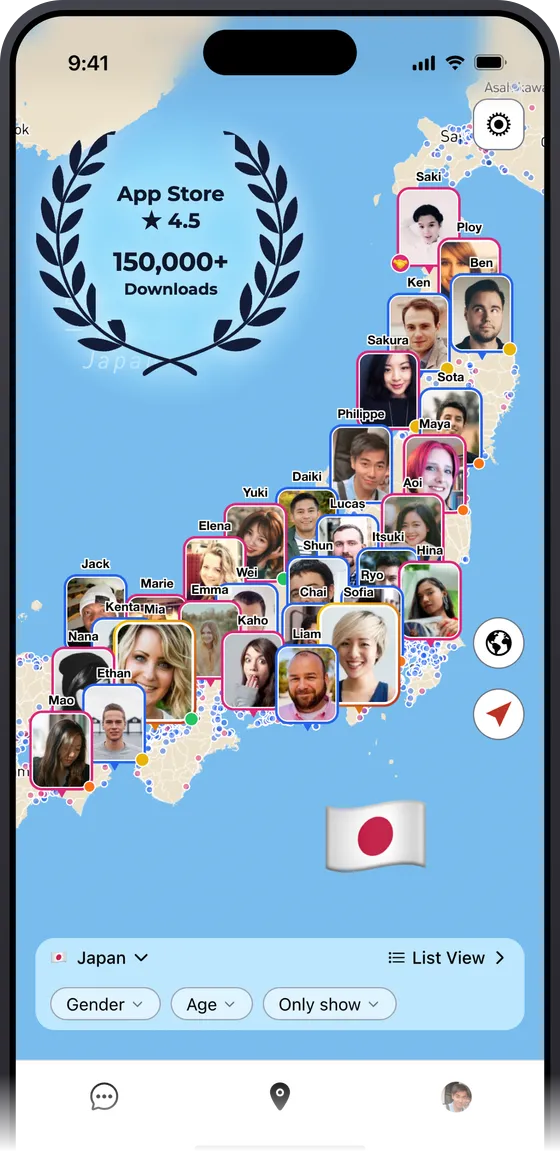
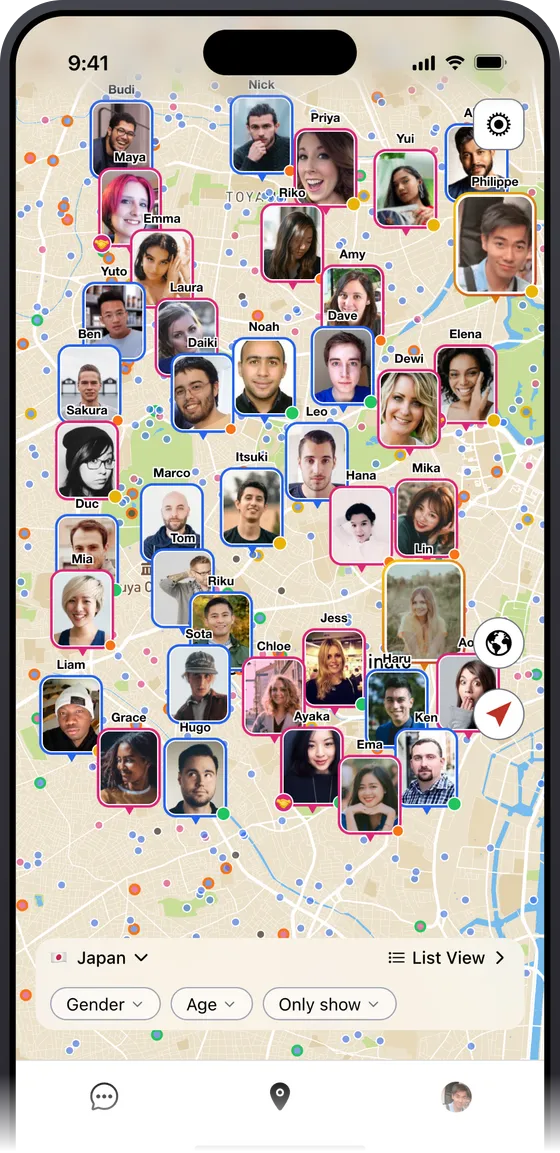
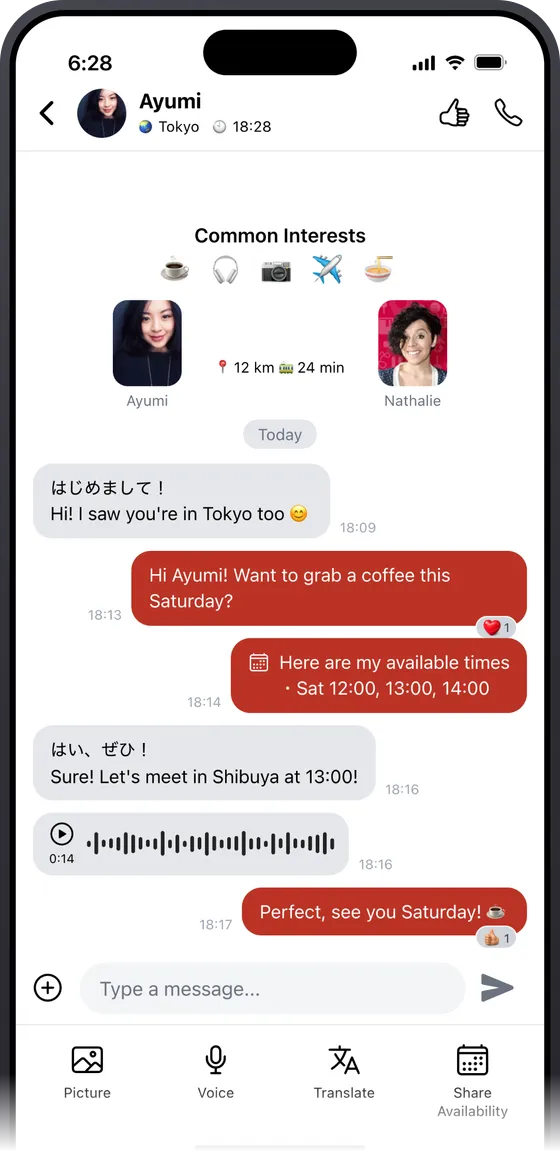


SewaYou works in every major city in the world. Tokyo, Paris, New York, São Paulo, Seoul, Jakarta. The map is wherever you are. Open the app. See who is close. Say hi to a person, not a profile.
If you are tired of being someone's backup, stop trying to match. Try being a neighbor instead.


