

If you are reading this, your friend circle has probably gone a little stale. Mine did too. Around 28 I noticed that everyone I knew had paired up, moved away, or quietly retreated into the bubble of work and family. The people I wanted in my life, curious people, people who had lived somewhere else, people who could surprise me in a conversation, were nowhere on my contact list.

So I did what every overstimulated adult does. I downloaded apps. A lot of them. Some helped. Most wasted my time. This is the honest version of what I learned trying to find international friends online in 2026.
Before the app rundown, the obvious thing nobody says out loud. Finding international friends as an adult is hard for a specific reason. It is not just about meeting new people, it is about meeting people who actually overlap with you in time, place, and life stage. The internet flattened distance for messaging but not for friendship. A pen pal in Lisbon is fun for two weeks. Then you remember you wanted someone to grab coffee with on Saturday.
The apps that work are the ones that respect that distinction. The ones that fail are the ones that pretend chat is the same thing as connection.
Make Japanese Friends On a Live World Map
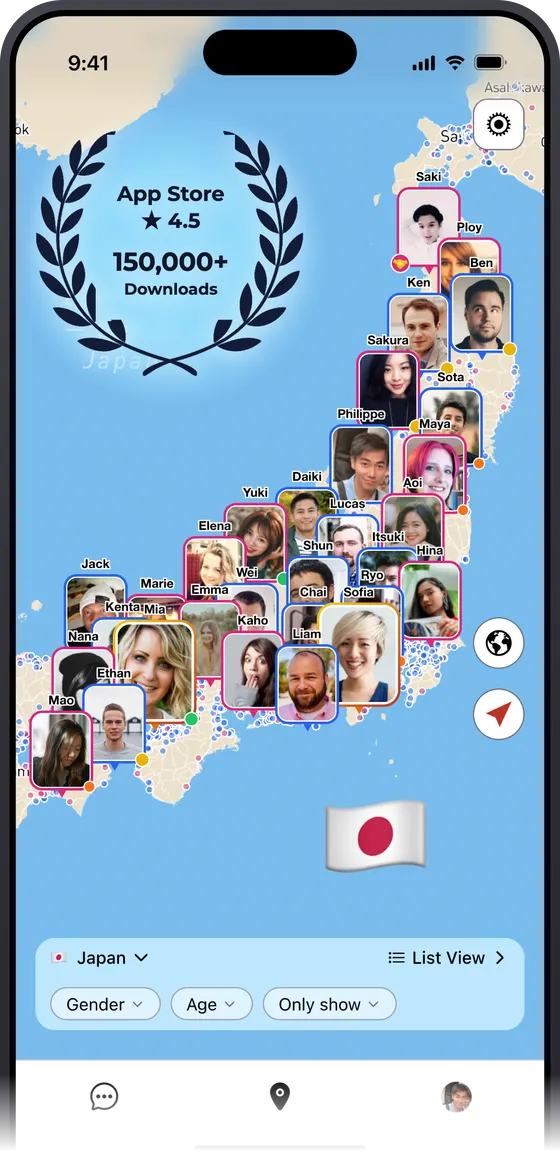
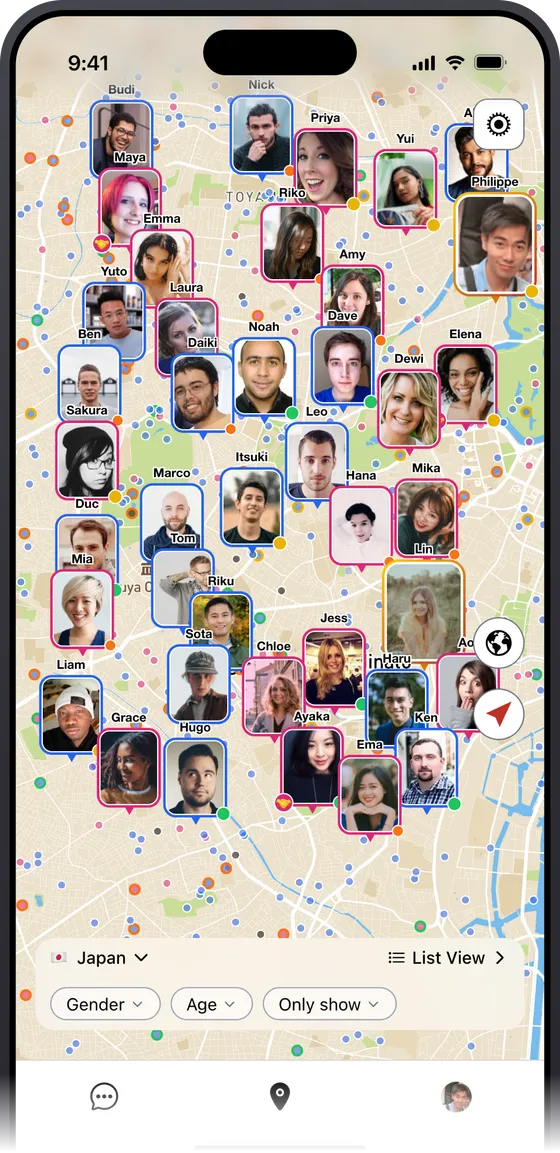
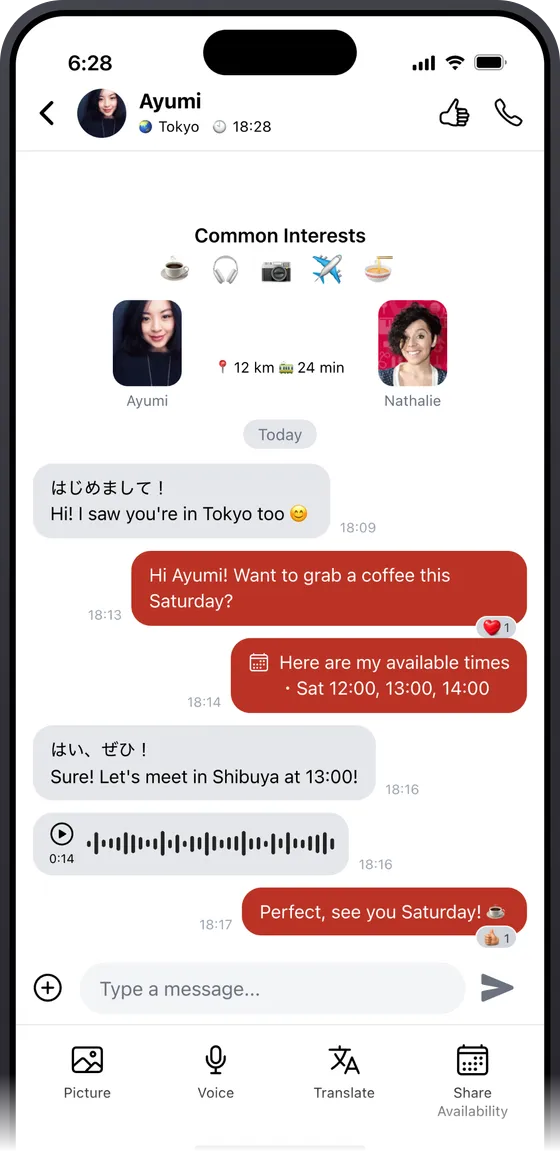


I am going to start with the app I genuinely use, because it is the one that solved the problem the others did not.
SewaYou is a map-based friend-finding app for people nearby and anywhere in the world. Explore any area on the world map, including a future destination before you travel. For local meetups, focus on your own area. You can see the foreigner studying Japanese two stations away, or the Japanese person in the next neighborhood who wants to practice English. Then you message, agree on a cafe, and you are doing the only thing that actually creates friendship, which is hanging out in person.
The map feature is the entire point. Friendship is a logistics problem disguised as an emotional one. Once you can see who is realistically meetable for a coffee this weekend, the whole thing stops being theoretical.
Whether you want a friend in your own neighborhood or in a country you have never visited, if you want real friends rather than another half-dead chat thread, this is the one I tell people to install first.
HelloTalk is a language exchange app with 70 million+ learners by its own count. It has built-in tools for translation, transliteration and corrections, so if your goal is to drill a language and get your sentences corrected, that is exactly what it is built for.
Its own safety FAQ says HelloTalk is not a dating app. In our view, it suits language practice more than finding a friend to meet. Know what you want before you install it.
If you want a vocabulary partner, install it. If you want a friend nearby, pair it with something local.

Tandem is a conversation exchange app with one-to-one chats, voice notes, audio and video calls, and message corrections. Like HelloTalk, it is built around language practice.
On both apps, finding members nearby is a paid feature: HelloTalk VIP includes searching for nearby HelloTalkers, and Tandem Pro includes finding members nearby or in a city. Without it, the person you click with may well live twelve time zones away, and you cannot get a beer with someone in São Paulo if you live in Saitama.
In our view, both work best for what they are designed for, which is language practice, rather than as friendship apps.
Bumble BFF is Bumble's friendship app. You build a profile with interests, chat one-on-one, join groups around shared hobbies and plan meetups, and Bumble says it helps you find people in the same city. Its App Store listing says every feature is free.
The upside is that it is made for friendship. In our view, it is built for local friends in general rather than for international friendships specifically, so the international angle depends on who lives in your city.
Bumble BFF is fine. It is not magic. If you are open to making any kind of friend, give it a go. If you specifically want cross-cultural friendships, expect to look around for a while before you find the right person.

I keep telling people to use Meetup and they keep ignoring me. Meetup is not flashy. It is built around groups and events, online and in person, where people show up in actual rooms.
This is the cheat code. Group activities take all the pressure off the one-on-one conversation. You show up to a language exchange, a board game night, a hiking group, and friendships happen sideways while you are doing something else. Search for international or language exchange groups in your city, and remember that everyone in the room made the effort to leave their apartment, which is already a filter you want.
The only catch is consistency. Going once does nothing. Going to the same group three or four times turns strangers into people who recognize you, and that is when the friendship part starts.
Discord is free to download and lets you hop in and out of voice or text chats without calling anyone. Search for language exchange servers for any language you care about and you will find communities with voice channels, regular events, and sometimes real-life meetups when members happen to be in the same city.
It is not for everyone. In a group chat, you usually have to show up for a while before anyone remembers you. But if you are introverted and the idea of swiping makes you tired, hanging out in a voice channel for a few weeks is a softer entry point. Group chats reward people who linger, which is almost the opposite of swipe-based apps.

A few things I tried that I would not bother with again.
Random pen pal sites with no plan to meet. Long-form letters sound romantic, but in my experience they rarely turned into a friendship I could see in person.
Massive global Facebook groups. With that many members spread across the world, it is hard to find anyone to actually meet.
Reddit DMs. Occasionally a great conversation, almost never a friendship that survives outside the platform. Reddit is for ideas, not friends.
Twitter/X followings. Parasocial. You think you know them. They have no idea who you are.
Online-only stops being friendship after a while. The thing that turns a chat partner into a friend is showing up somewhere in person. Every app I listed above is only as useful as the meetup it eventually leads to. The ones that get you there fastest, like SewaYou with its map feature, or Meetup with its event list, deliver more friendships per hour spent than the global chat apps that keep you scrolling forever.
Location-aware beats global. Three hours at a cafe with one person beats three months of texting five.
Install SewaYou, open the map, message one person who lives near you, and propose a coffee for Saturday. That is the entire game.
If you are not in Japan, open Meetup, find one international or language exchange group meeting this week, and just go. Bring nothing but yourself.
The apps are tools. The friendships happen when you put the phone down and show up.
Stop scrolling, start meeting. SewaYou is the map-based app that gets you from "I should make more international friends" to actual coffee with someone interesting this weekend. Built for people who are tired of chat threads that go nowhere.


